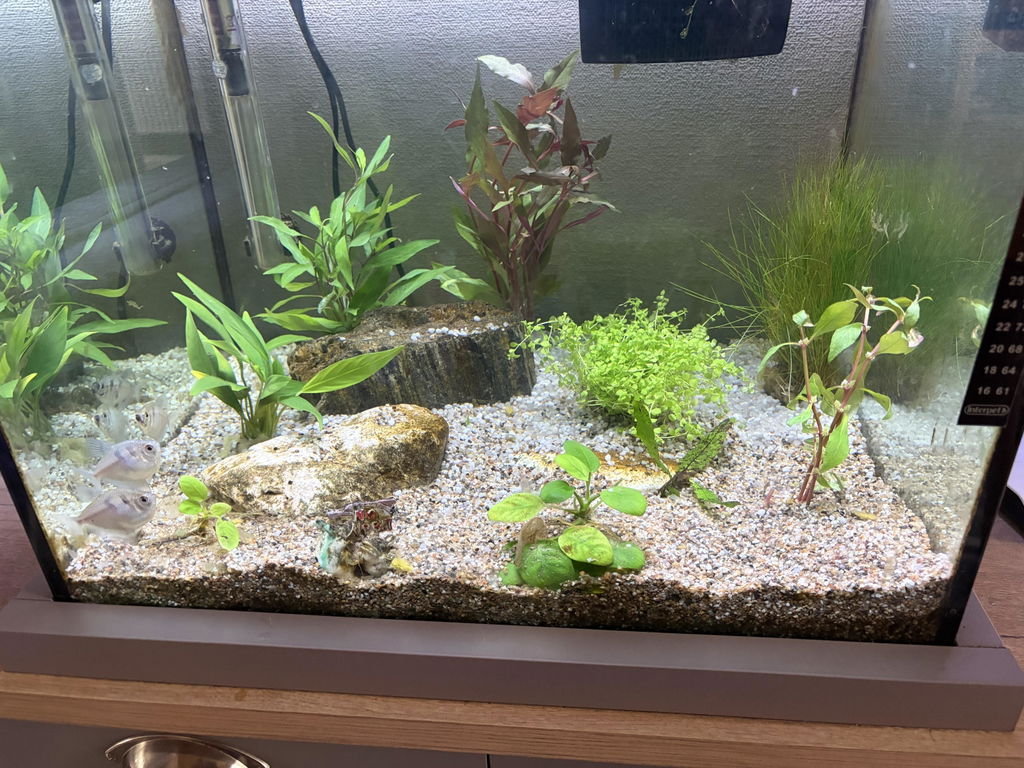


Rotala rotundifolia is one of the most popular stem plants in the hobby — and probably the most misunderstood. People buy it green, wonder why it doesn’t turn red, and either blame their lighting or give up entirely. The truth is that the colour is a direct response to what the plant is experiencing. Get the conditions right and it transforms. Here’s everything you need to know.
What Rotala rotundifolia Actually Is
Rotala rotundifolia is a stem plant native to Southeast Asia — India, Sri Lanka, Japan, and much of South East Asia. In the wild it grows in shallow, seasonally flooded areas, often in bright, nutrient-rich conditions. This background explains a lot about how it behaves in an aquarium.
It’s a fast grower by planted tank standards. Under good conditions, stems add 3–5cm per week and can reach the surface of a 40cm tank within a month of planting. Left untrimmed, the stems get leggy at the base and top-heavy at the surface. Regular trimming isn’t optional — it’s how you get the dense, bushy shape the plant is known for.
The leaves are small and rounded (hence “rotundifolia” — round-leaved), arranged in pairs up the stem. Under low light they stay dark green. Under high light, with CO² and nutrients in the mix, they shift through orange and pink to a deep reddish-copper. The same plant can look entirely different depending on conditions.
Why It Changes Colour — and How to Make It Happen
The colour shift in Rotala is driven by anthocyanins — pigments the plant produces in response to stress. High light intensity, CO², and slightly low nitrogen levels all push the plant toward red production. Here’s how each factor contributes:
Light is the most important lever. Rotala needs medium-to-high light intensity to show good colour — an LED running at 50–70% capacity for 8 hours a day is a good starting point. At low light, it stays green and grows slowly but won’t colour up no matter what else you do.
CO² supercharges the result. Without CO², Rotala can turn a mild orange-pink in good light. With pressurised CO², those same stems can go deep copper-red within a few weeks. CO² isn’t strictly required for Rotala to survive — it will grow without it — but if you want the colour the plant is famous for, CO² makes a significant difference. Liquid carbon is a good intermediate step: it won’t match a pressurised system, but it does push colouration noticeably compared to using nothing.
Nutrients need to be present but not excessive. Paradoxically, very high nitrogen levels keep the plant green — it doesn’t need to produce anthocyanins to protect against stress. A slightly lean but balanced fertiliser routine, with adequate phosphate and iron, tends to produce better colour than overdosing nutrients.
From Aqua Essentials
Our Rotala rotundifolia is supplied as healthy stems ready to plant. It arrives green — that’s normal for transit — and will colour up as it adjusts to your tank’s conditions over the first few weeks.
Shop Rotala rotundifolia →How to Plant Rotala rotundifolia
Rotala is a stem plant, which means you’re planting individual stems rather than a whole plant with roots. When it arrives, it may come as a bunch held together with a lead weight or rubber band — remove this before planting; leaving it on causes stem rot at the base.
Separate the bunch into individual stems. Remove the lowest 2–3cm of leaves to expose bare stem for planting — these leaves would rot if buried anyway. Use aquascaping tweezers to push each stem 3–4cm into the substrate. Don’t compact the substrate too tightly around them; the stems will anchor themselves as they grow roots over the first week or two.
Plant in groups for the best effect. A single stem looks sparse; a cluster of 7–15 stems planted 1–2cm apart creates the dense, voluminous background that makes Rotala so popular in aquascaping. The stems grow upward together, gradually forming a column of foliage that catches the light.
It works in most substrates — soil, sand, or gravel. Like all stem plants, it doesn’t rely heavily on substrate nutrition because it feeds primarily through the water column. That said, it does better in a soil substrate with a regular liquid fertiliser routine.
How to Trim Rotala (This Is Important)
Trimming is what makes Rotala look good. Untrimmed stems become bare at the base as the plant puts energy into upward growth, leaving you with a “triffid” effect — long bare stems topped with a canopy. Regular trimming reverses this and creates the dense bushiness that makes Rotala photographs so striking.
The basic technique: cut the top 5–8cm off each stem with aquascaping scissors. Don’t throw the tops away — replant them. The cut stump will sprout 1–3 new side shoots just below the cut point, each of which grows upward and can be trimmed again. Repeat this process every 2–4 weeks and after a few cycles you’ll have a genuinely dense mass of stems.
When the base gets too bare: pull out the old stems entirely and replant fresh tops from the trimmings. This sounds drastic but Rotala recovers quickly — within 2–3 weeks a newly planted set of tops looks better than an overgrown old planting.
Trimming tip for colour: the tops of the stems tend to colour up most intensely because they receive the most light. Trim conservatively and keep the coloured tips where possible. Trim more heavily from the sides and lower portions that receive less light.
Feeding Rotala
Rotala is a moderate feeder — not as demanding as some stem plants, but it does better with regular fertilisation than without. The key nutrients are:
Iron is particularly important for red colouration. Iron-deficient Rotala shows pale new growth and poor colour even in strong light. Look for a fertiliser that includes chelated iron rather than just NPK (nitrogen, phosphorus, potassium).
Potassium and phosphate support healthy cell structure and photosynthesis. In a tank with regular water changes and a balanced fish load, these are often adequately supplied, but in a low-stocked or heavily planted tank, dosing them separately makes a difference.
From Aqua Essentials
The Neutro Combo covers both liquid fertiliser and liquid carbon in one simple weekly routine — a good starting point if you’re running a low-tech tank. For tanks with pressurised CO², pair a comprehensive all-in-one fertiliser with your CO² system for the best colour results.
Shop Fertilisers →Aquascaping With Rotala rotundifolia
Rotala is almost always used as a background or midground plant. Its height (20–40cm when grown out) and fine-leaved texture make it a natural backdrop for lower-growing foreground plants. The colour contrast — green and red stems behind a green carpet or against a dark substrate — is one of the most classic combinations in planted tank aquascaping.
A few design principles that work well with Rotala:
Group it in an odd number of clusters: three groups of varying sizes creates a more natural look than a single continuous hedge. Plant the largest group toward the back corner and taper toward the centre.
Mix stem heights deliberately: letting one section grow slightly taller before trimming creates depth and movement rather than a flat, uniform wall.
Contrast with green: the red/orange tones of Rotala look best against deep green plants. Java Fern, Anubias, and Java Moss on hardscape in the mid-foreground create excellent contrast with Rotala in the background.
For a deeper red planting — an “Iwagumi meets red” style — combine Rotala with Alternanthera cardinalis, which offers broader, deeper red leaves. The different leaf shapes and red intensities together create a much richer effect than either plant alone.
From Aqua Essentials
Browse our full Red Aquarium Plants collection for species that complement Rotala — from deep crimson Alternanthera to the softer pinks of Ludwigia and beyond. A mix of reds creates far more visual depth than a single species.
Browse Red Plants →Common Questions
My Rotala arrived green — is it the wrong plant? No. Rotala is almost always green when purchased. It was likely grown emersed (above water) or under low light in a nursery setting. The red colouration only appears once it has settled into your tank conditions and has access to sufficient light, CO², and nutrients. Give it 3–4 weeks before judging.
Can Rotala grow without CO²? Yes — it grows in low-tech tanks without CO², just more slowly and with green rather than red foliage. If you add liquid carbon and run good lighting, you’ll get some orange-pink tones. Pressurised CO² is the route to deep red, but it’s not required for the plant to thrive.
Why are the lower leaves dropping? This is normal for mature stem plants. As the plant grows upward, the lower portion receives less light and the leaves there die off. This is why regular trimming and replanting tops is important — you’re constantly refreshing the base of the planting.
Is it safe for fish, shrimp, and snails? Completely. Rotala is non-toxic and has no reported issues with any commonly kept fish or invertebrates. Shrimp particularly like grazing on the fine leaves and the biofilm that accumulates on them.
How do I stop it growing so fast? Reduce lighting duration (try 6–7 hours instead of 8–10), reduce fertiliser dosing, and trim more frequently. You can also reduce CO² levels slightly if you’re running a pressurised system. Note that very slow growth in Rotala often means it’s lacking something — fast growth with regular trimming is usually healthier than stunted growth.