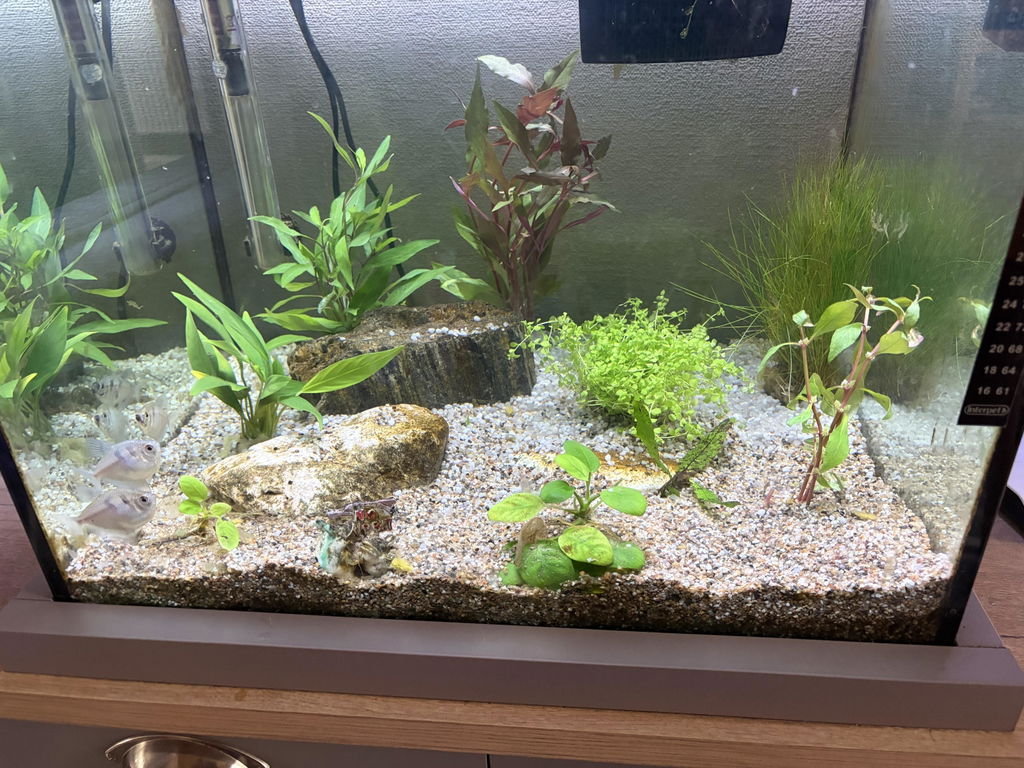


Some fish eat plants. It's that simple — and if you've got a tank full of voracious nibblers, your choice of plant matters enormously. The good news is that certain species are either unpalatable to fish (tough, waxy, or bitter-tasting leaves) or grow fast enough to outpace even determined herbivores.
Here's a practical guide to fish-proof planting.
Which fish are the biggest plant-eaters?
Some species are notorious for destroying planted tanks. If you keep any of the following, you'll need to choose your plants carefully:
- Goldfish — will eat almost anything soft and leafy; a classic combination with plants that rarely ends well
- Silver dollars — dedicated herbivores that will strip a tank bare in days
- Large cichlids (Oscars, Jack Dempseys) — destructive diggers that uproot as much as they eat
- Buenos Aires tetras — surprisingly aggressive plant-eaters for a small fish
- Tinfoil barbs and larger barbs — fast-growing herbivores with appetite to match
- Many pleco species — will rasp at broad-leaved plants like Amazon swords overnight
In contrast, most small community fish — tetras, rasboras, corydoras, small livebearers — pose little or no threat to the plant species below.
The most fish-resistant aquarium plants
Anubias
Anubias leaves are thick, waxy, and apparently taste unpleasant to most fish. Even goldfish tend to leave them alone. They're slow-growing epiphytes that attach to wood or rock, need no substrate, and thrive in low light. Anubias nana is the most popular — compact, sturdy, and almost indestructible. Anubias barteri grows larger and works well as a midground feature plant.
Java Fern (Microsorum pteropus)
One of the few plants that fish consistently refuse to eat. The leaves contain compounds that make them unpalatable, which is why Java Fern is almost universally recommended for problem fish setups. It's also extremely hardy — low light, no CO2 required, and grows attached to wood or rock rather than in substrate.
Java Moss (Taxiphyllum barbieri)
Java Moss grows fast enough that even nibbling fish can't keep up with it. Tie it to driftwood, drop it on rocks, or let it float — it will establish itself almost anywhere. Fish also use dense moss patches as cover and spawning sites, which means they're often more interested in living in it than eating it.
Cryptocoryne
Crypts have tough, leathery leaves that most fish ignore. They're also root-feeders that establish a substantial root system — making them difficult to uproot — and come in a wide range of sizes and leaf shapes. Cryptocoryne wendtii is a good starting point: undemanding, mid-sized, and highly tolerant of varying conditions.
Echinodorus (Amazon Sword)
Broad, firm leaves mean the Amazon Sword holds up better than softer plants. It's not completely immune — large cichlids and goldfish will eventually have a go — but for most community tanks it's a solid background plant that fish leave alone. Grows quickly once established.
Floating plants
Hornwort, Egeria densa, and similar fast-growing stem plants used as floating cover can work well in herbivore tanks — they grow so quickly that they effectively renew themselves faster than fish can consume them. They also provide excellent surface cover and help reduce nitrates.
From Aqua Essentials
We've put together a dedicated collection of plants that consistently stand up to fish. Browse our full non-edible aquarium plants range — everything there has been selected for its resistance to nibbling, grazing, and general fish interference.
Shop Fish-Resistant Plants →Practical tips for planting with destructive fish
Plant densely from the start. Sparsely planted tanks invite fish to investigate every plant individually. Dense planting overwhelms them — there's simply too much to nibble, and they tend to leave most of it alone.
Attach plants to hardscape. Epiphytes like Anubias and Java Fern fixed to wood or rock can't be uprooted, which eliminates one of the main problems with digging cichlids and larger fish.
Feed your fish well. Many fish eat plants partly out of boredom or nutritional need. Supplement dry food with blanched vegetables (courgette, spinach, peas) to reduce their interest in your planted tank.
Avoid soft-leafed plants. Delicate species like Cabomba, Limnophila, and Hornwort stems are easily shredded. Stick to the tougher species listed above until you know your fish's behaviour.
Frequently asked questions
Will goldfish eat all aquarium plants?
Goldfish will eat most soft-leafed plants, but they tend to leave Anubias and Java Fern alone. Both species have leaves that goldfish find unpalatable, making them the most reliable choices for goldfish tanks.
Why do fish eat aquarium plants?
Fish eat plants for several reasons: natural herbivorous instinct, nutritional need (particularly for fibre and plant matter), boredom in an understimulating environment, or simple opportunism. Supplementing with vegetables can reduce plant damage in some species.
Are there any plants cichlids won't eat?
Anubias and Java Fern are the most reliable choices for cichlid tanks, particularly when attached to hardscape so they can't be uprooted. Large cichlids can still damage even these over time, so attach them securely and plant densely.