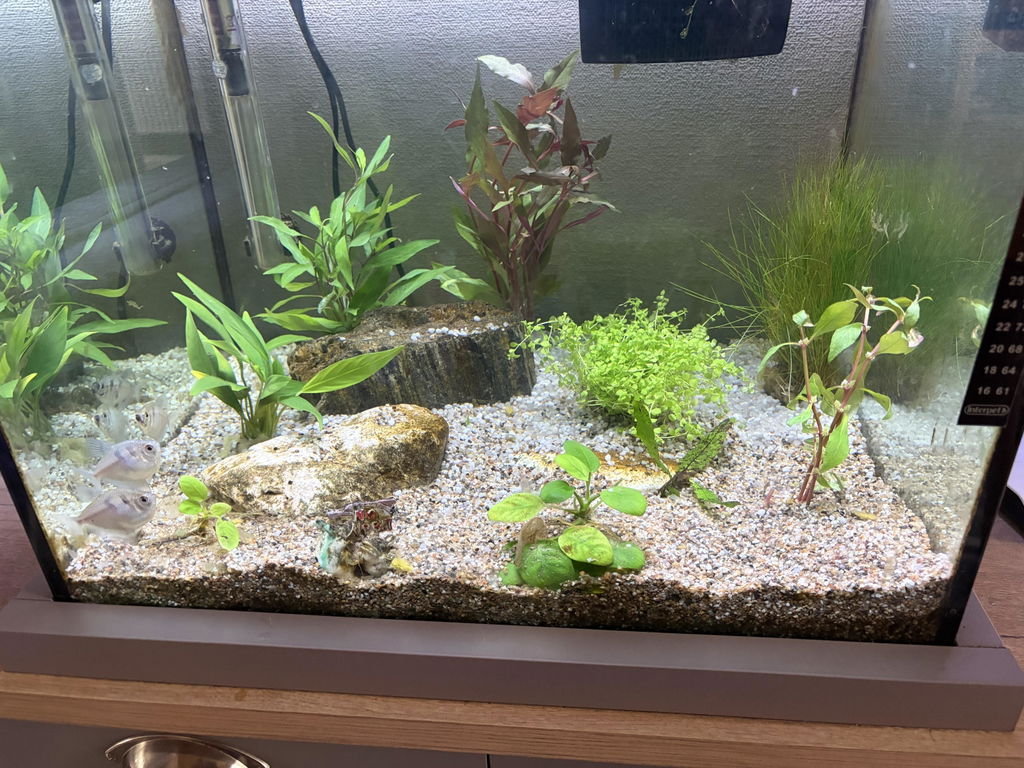


If you've looked at aquarium plants lately you've seen the sealed cups — small pots of vivid green plantlets in clear jelly. They're tissue culture plants, also called in-vitro or 1-2-Grow plants, and they answer a question every planted-tank keeper eventually asks: how do I add plants without adding problems? This guide covers what they are, whether they're worth the money, how to plant them, and which to pick.
What tissue culture plants are
Tissue culture plants are grown in a lab from a small piece of parent plant, raised in sterile nutrient gel inside a sealed cup. Because the cup is sealed from day one, nothing gets in — no aquarium water, no hitchhikers, no spores. One cup holds many small plants that you divide into several portions, so a single cup goes further than it first looks.
Most of our tissue culture plants are grown by Tropica in Denmark under their 1-2-Grow! label, spanning carpets, stems, mosses and epiphytes.
Are they worth it?
The honest case is one thing, not a list of vague benefits: because the plants have never touched aquarium or nursery water, they arrive free of snails, snail eggs, planaria, hydra and algae. Pest snail outbreaks and hair algae almost always arrive on new plants — a sealed cup removes that route entirely.
They're grown without pesticides too, which matters if you keep shrimp, since some conventionally grown plants carry residues that shrimp react badly to. If you keep Cherry or Caridina shrimp, tissue culture is the low-risk choice, and it pairs naturally with the rest of our shrimp accessories. The trade-off is honest: you get younger, smaller plants than a mature pot, so a scape takes a little longer to fill in. For a new setup or a shrimp tank, that trade is usually worth it.
From Aqua Essentials
We carry one of the largest tissue culture ranges in the UK — over 100 species, from carpets to Bucephalandra, all delivered in sealed, sterile cups.
Shop tissue culture plants →How to plant a tissue culture cup
It takes ten minutes and needs only tweezers and a bowl of water. Open the cup, lift out the plant mass, and rinse the jelly off gently — leftover nutrient gel feeds algae, so take your time. Then divide the mass into small portions.
For carpets like Tropica Micranthemum Monte-Carlo 1-2-GROW!, plant portions a couple of centimetres apart across the foreground and let them knit together. Stems and midground plants go in as small clumps. Plant deep enough that portions stay anchored and they'll root within a couple of weeks. Because the plantlets are young, they adapt to your water as they grow rather than melting back the way some emersed-grown pots do.
Do they have to go straight in?
No. An unopened cup keeps for a couple of weeks in a cool, lit spot — a bright windowsill out of direct sun is fine. Once opened, plant it. Keeping cups too long or too warm is the usual reason they arrive looking tired.
Which ones to buy
If you're carpeting, start with Monte-Carlo or a hairgrass. If you want something forgiving and low-light, the Anubias, Bucephalandra and Java Fern epiphytes are near indestructible and don't need planting into substrate at all. For a first planted tank, our beginner aquarium plants are chosen to grow with or without CO2. And for the adventurous, rarities like Tropica Utricularia graminifolia 1-2-GROW! are only really practical in tissue culture form.
Every cup we send leaves Devon in the same sealed, sterile condition it arrived in from the lab. If you're not sure which species suit your tank, get in touch before you buy — we're happy to point you the right way.