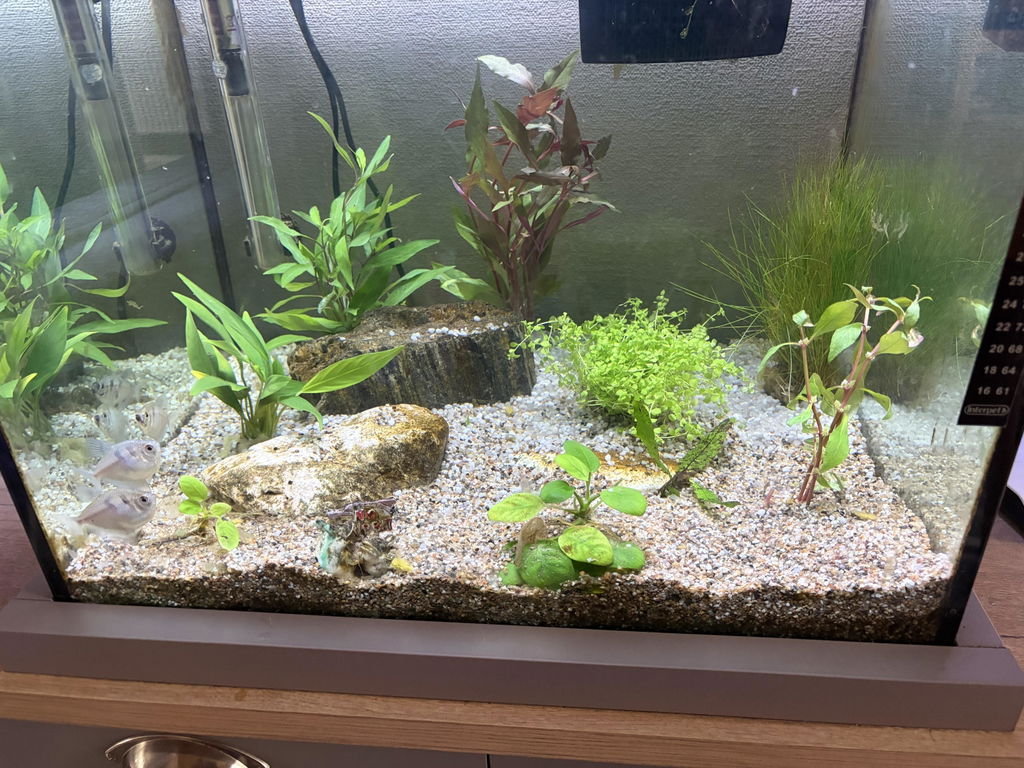


If you've ever looked at a lush planted tank and assumed you'd need expensive CO₂ equipment to pull it off, think again. A huge range of aquarium plants grow beautifully in a low-tech setup — no pressurised CO₂, no regulators, no solenoids. Just water, light, and a little know-how.
In this guide, we'll walk you through the 10 best aquarium plants that don't need CO₂, why they work, what they do need instead, and how to set your tank up for success from day one.
Why Go CO₂-Free?
A pressurised CO₂ system can cost anywhere from £80 to £300+ to set up, and it requires regular maintenance — refilling cylinders, checking pH, calibrating diffusers. For beginners especially, it adds complexity before you've even chosen your fish.
The good news: the majority of aquarium plants sold in the UK are perfectly happy without it. Low-tech planted tanks are lower cost, lower maintenance, and — when done right — just as beautiful. They're also far more forgiving if you miss a water change or forget to dose for a week.

What Makes a Plant Easy Without CO₂?
Not all aquarium plants are equal. Some — like Glossostigma or HC Cuba — are fast-growing, high-demand plants that genuinely need injected CO₂ to thrive. Others have adapted to grow slowly and extract dissolved CO₂ directly from the water column, which is always present in any healthy aquarium.
A true no-CO₂ plant typically has three things going for it:
Slow to moderate growth rate — less carbon demand overall
Tolerance for low to moderate light — strong light drives faster growth, which then demands more CO₂
Ability to absorb nutrients through leaves as well as roots — especially useful for epiphytes like Anubias and Java fern
If a plant ticks these boxes, it'll thrive in a low-tech tank with good fertilisation and sensible lighting.
The 10 Best Aquarium Plants Without CO₂
1. Java Fern (Microsorum pteropus)
Difficulty: Easy | Position: Midground to background | Light: Low to medium
Java fern is arguably the most beginner-friendly plant in the hobby. Its tough, dark green leaves are slow-growing and virtually indestructible, and it's one of the few plants that fish like goldfish and cichlids tend to leave alone.
Crucially, Java fern is an epiphyte — it doesn't root into substrate at all. Instead, it attaches to wood or rock with its rhizome. Burying the rhizome will kill it, so tie or glue it to a piece of hardscape and let it do its thing.
Why it works without CO₂: Its slow growth rate means it draws very little carbon. It absorbs nutrients and CO₂ directly through its leaves from the water column, making it ideal for low-tech tanks.
Browse our epiphyte collection to find Java fern in several varieties, including Narrow Leaf, Trident, and Windeløv.
2. Anubias (Anubias barteri and varieties)
Difficulty: Easy | Position: Foreground to midground | Light: Low to medium
Anubias is the holy grail of low-maintenance aquarium plants. It grows slowly, tolerates a wide range of water conditions, thrives in low light, and can live for years without any intervention. It also flowers underwater, which is a genuinely impressive sight.
Like Java fern, Anubias is an epiphyte — attach it to wood or rock rather than burying it in substrate. It comes in several sizes, from the compact Anubias nana (perfect for nano tanks) to the broader-leafed Anubias barteri for larger setups.
Why it works without CO₂: Anubias is one of the most low-demand plants in existence. Its thick leaves store nutrients efficiently, and its slow growth rate means it never outpaces the natural CO₂ available in the water.
Shop Anubias varieties — many available already attached to wood or rock, ready to place straight in your tank.
3. Java Moss (Taxiphyllum barbieri)
Difficulty: Easy | Position: Foreground, on hardscape, or floating | Light: Low to medium
Java moss is one of the most versatile plants in the hobby. It can be tied to wood or rock to create natural-looking moss patches, left to float freely, or used to carpet the foreground of a tank. It also provides excellent cover for shrimp and fry, making it a favourite in breeding setups.
It's a fast grower relative to other no-CO₂ plants, which means it competes well with algae — a major advantage in a low-tech tank.
Why it works without CO₂: Moss absorbs everything it needs — CO₂, nutrients, light — directly from the water column. It has no roots and no complex internal structure that demands high carbon input.
Read our full guide to the best moss for planted aquariums for a breakdown of moss species and how to use them.
From Aqua Essentials
We stock a full range of aquarium mosses — Java Moss, Christmas Moss, Weeping Moss and more. All attach to wood or rock and thrive without CO².
Browse Aquarium Mosses →4. Cryptocoryne (Cryptocoryne spp.)
Difficulty: Easy to moderate | Position: Foreground to midground | Light: Low to medium
Cryptocorynes — or 'Crypts' — are the backbone of countless low-tech planted tanks. They're rooting plants that draw nutrients primarily from the substrate, come in a wide range of leaf shapes and colours (green, brown, red, ruffled, narrow), and are highly adaptable to different water conditions.
One note: Crypts can go through 'Crypt melt' when first introduced — leaves die back as the plant adjusts from its nursery conditions to your tank. Don't panic. Leave the roots in place, and new growth will follow within a few weeks.
Why it works without CO₂: Crypts grow slowly and rely heavily on root nutrition rather than water column CO₂. A good substrate or root tabs makes them almost self-sufficient.
5. Vallisneria (Vallisneria spiralis / Vallisneria natans)
Difficulty: Easy | Position: Background | Light: Low to high
Vallisneria — often called Val or Tape Grass — produces long, ribbon-like leaves that sway gracefully in the current, creating an instant natural riverbed effect. It's a fast grower for a low-tech plant, and it spreads by sending out runners, eventually filling the background of your tank on its own.
It's also one of the best plants for oxygenating the water and outcompeting algae through nutrient uptake.
Why it works without CO₂: Vallisneria pulls nutrients and CO₂ through both its leaves and its roots. It's naturally found in slow-moving rivers and lakes where CO₂ levels are modest, making it well-adapted to low-tech conditions.
6. Amazon Sword (Echinodorus bleheri)
Difficulty: Easy | Position: Midground to background | Light: Medium
The Amazon sword is a classic for a reason. It produces large, broad, bright green leaves that create an impressive centrepiece in any planted tank, and it's tough enough to handle a wide range of conditions. It's also a popular choice for cichlid tanks, as it holds up well against larger, more boisterous fish.
Amazon swords are heavy root feeders, so they benefit significantly from a nutrient-rich substrate or the addition of root tabs placed near the base.
Why it works without CO₂: Like Cryptocoryne, the Amazon sword gets most of its nutrition — including carbon — through its root system, reducing its dependence on dissolved CO₂ in the water column.
Shop Amazon sword — one of our best-selling plants.
7. Hornwort (Ceratophyllum demersum)
Difficulty: Very easy | Position: Background or floating | Light: Low to high
Hornwort is one of the fastest-growing stem plants you can keep without CO₂ — and that speed is one of its greatest advantages. By growing rapidly, it absorbs excess nutrients from the water before algae can, making it an excellent natural algae suppressant in new or unbalanced tanks.
It can be planted in substrate or left floating freely, and it works well in both tropical and coldwater setups.
Why it works without CO₂: Hornwort is highly efficient at extracting dissolved CO₂ directly from the water. It actually releases allelopathic chemicals that inhibit algae growth — an added bonus for any low-tech tank.
8. Bacopa (Bacopa caroliniana / Bacopa monnieri)
Difficulty: Easy | Position: Midground to background | Light: Medium
Bacopa is a compact, upright stem plant with small, round leaves and a pleasant, slightly aromatic quality when handled. It grows at a manageable pace without CO₂, making it easy to maintain and trim. Under good lighting, it can develop reddish hues at the tops of its stems, adding a subtle colour contrast to a green tank.
It's particularly good for adding structure and height variation to the midground of a planted aquascape.
Why it works without CO₂: Bacopa's moderate growth rate keeps its CO₂ demand low. It draws freely from dissolved CO₂ in the water column and responds well to liquid fertilisation.
9. Marimo Moss Ball (Aegagropila linnaei)
Difficulty: Very easy | Position: Foreground or resting on substrate | Light: Low
Marimo moss balls are a unique and charming addition to any aquarium. Despite the name, they're not actually moss — they're a naturally forming spherical algae colony from cold lakes in Japan and Iceland. They grow extremely slowly (just 5mm per year on average), require virtually no care, and improve water quality by absorbing nitrates.
They're particularly popular in nano tanks, shrimp tanks, and alongside bettas, where their gentle, ornamental quality fits perfectly.
Why it works without CO₂: Marimo moss balls have almost zero carbon demand. Their slow growth means they extract only tiny amounts of CO₂ from the surrounding water.
Read our complete guide to aquarium moss balls for care tips and troubleshooting.
10. Floating Plants — Salvinia, Frogbit & Duckweed
Difficulty: Very easy | Position: Water surface | Light: Medium to high
Floating plants deserve a category of their own because they're some of the most effective low-tech plants you can add to a tank. Salvinia natans, Amazon frogbit, and duckweed all grow rapidly at the surface, pulling nutrients directly from the water column and shading the tank below — which naturally reduces algae on the glass and substrate.
They also provide natural cover for surface-dwelling fish and shrimp, and their dangling roots offer excellent spawning habitat.
Why they work without CO₂: Floating plants have direct access to atmospheric CO₂ through their leaves, which sit above the waterline. They don't rely on dissolved CO₂ in the water at all, making them uniquely well-suited to low-tech tanks.
Discover more in our guide to the most popular floating aquarium plants.
What Fertiliser Do Low-Tech Plants Still Need?
Here's the thing: going CO₂-free doesn't mean going nutrient-free. Your plants still need macronutrients (nitrogen, phosphorus, potassium) and micronutrients (iron, manganese, zinc) to grow healthily. Without them, even the easiest plants will show pale, yellowing leaves or stunted growth.
The simplest solution for a low-tech tank is an all-in-one liquid fertiliser added weekly. Our Neutro Combo is formulated specifically for low-tech tanks — it provides everything your plants need without pushing them into growth rates that would demand CO₂ injection.
For root-feeding plants like Amazon sword, Cryptocoryne, and Vallisneria, root tabs placed near the base of the plant every few months make a significant difference. They slowly release nutrients directly into the substrate where the roots can access them.
Browse our full fertiliser range to find the right option for your setup.
From Aqua Essentials
The Neutro Combo is our most popular fertiliser kit for low-tech tanks — liquid all-in-one fertiliser paired with liquid carbon. One simple weekly dose covers everything in this list.
Shop Neutro Combo →Lighting: The One Thing That Replaces CO₂
If there's a single upgrade that makes the biggest difference in a low-tech planted tank, it's getting the lighting right.
Plants use light as the energy source to drive photosynthesis — and in a CO₂ free tank, moderate, consistent lighting is the lever that controls how well they grow. Too little and plants stagnate. Too much and you'll trigger algae blooms, because the plants simply can't photosynthesise fast enough without additional CO₂ to use all that energy.
For most low-tech setups, aim for 6–8 hours of light per day using a quality LED aquarium light. Modern LED lights offer far more control than old fluorescent tubes — many include timers, dimming, and spectrum adjustment, all of which help you dial in the right conditions.
A good rule of thumb: if algae is growing faster than your plants, reduce the photoperiod by an hour. If plants look pale or leggy, increase it slightly.
Should You Ever Add Liquid Carbon Instead?
Liquid carbon — products like Easy Carbo or Neutro Carbon — is sometimes described as a "CO₂ alternative," though it's more accurate to call it a supplement. It doesn't inject CO₂ into the water the way a pressurised system does, but it does provide an organic carbon source that plants can absorb through their leaves.
The real benefit of liquid carbon in a low-tech tank is algae control. At the recommended dose, it acts as a mild algaecide — particularly effective against stubborn spot algae and black beard algae (BBA) — while also giving your plants a gentle growth boost.
It's an excellent middle ground for tanks where fertilisation alone isn't quite keeping algae at bay, without the cost and complexity of a full CO₂ setup.
Browse our liquid carbon range to find the right option for your tank size.
FAQ: No-CO₂ Planted Tanks
Can aquarium plants grow without CO₂?
Yes — the majority of aquarium plants sold in the UK grow perfectly well without injected CO₂. Plants like Java fern, Anubias, Cryptocoryne, Vallisneria, and mosses all thrive in low-tech tanks by absorbing dissolved CO₂ naturally present in aquarium water.
What substrate do low-tech plants need?
For epiphytes like Java fern and Anubias, substrate doesn't matter — they attach to wood or rock. For rooting plants like Amazon sword and Cryptocoryne, a nutrient-rich aquarium substrate or the addition of root tabs will significantly improve growth. A fine gravel or sand can work for low-demand plants, but dedicated plant substrate gives better long-term results.
Do floating plants need CO₂?
No. Floating plants like Salvinia, frogbit, and duckweed access atmospheric CO₂ directly through their leaves, which sit above the waterline. They are among the most self-sufficient plants you can keep and are an excellent choice for low-tech tanks.
How do I stop algae in a low-tech tank?
Algae in a low-tech tank is usually caused by an imbalance between light, nutrients, and plant growth. The most effective approach is: reduce your lighting period to 6–7 hours, add fast-growing plants (Hornwort, floating plants, Vallisneria) to outcompete algae for nutrients, dose a liquid fertiliser consistently so plants stay healthy and competitive, and consider a small dose of liquid carbon as a direct algae suppressant. Our anti-algae collection also includes targeted treatments for stubborn cases.
Is a beginner plant box a good way to start a low-tech tank?
Absolutely. Our Easy Mixed Box of Aquarium Plants contains a curated selection of low-maintenance plants chosen specifically for beginners.
Do I need a heater for these plants?
Most of the plants in this list are tropical and prefer water temperatures between 22–28°C, so a heater is recommended. However, some — like Vallisneria, hornwort, and Java moss — are adaptable enough to tolerate cooler, unheated tanks. For a full list of cold-water-friendly options, see our cold water aquarium plants blog.
Ready to Plant Your Low-Tech Tank?
A CO₂-free planted tank isn't a compromise — it's a genuinely enjoyable, low-maintenance way to keep live plants. With the right plant selection, a quality liquid fertiliser, and sensible lighting, you can create a lush, natural-looking aquarium that practically looks after itself.
Browse our Easy Care plant collection, try the Beginner Box, or pick up Neutro Combo to get started.
All plants are dispatched from our UK facility — order before 4pm for same-day dispatch, with most arriving next day.