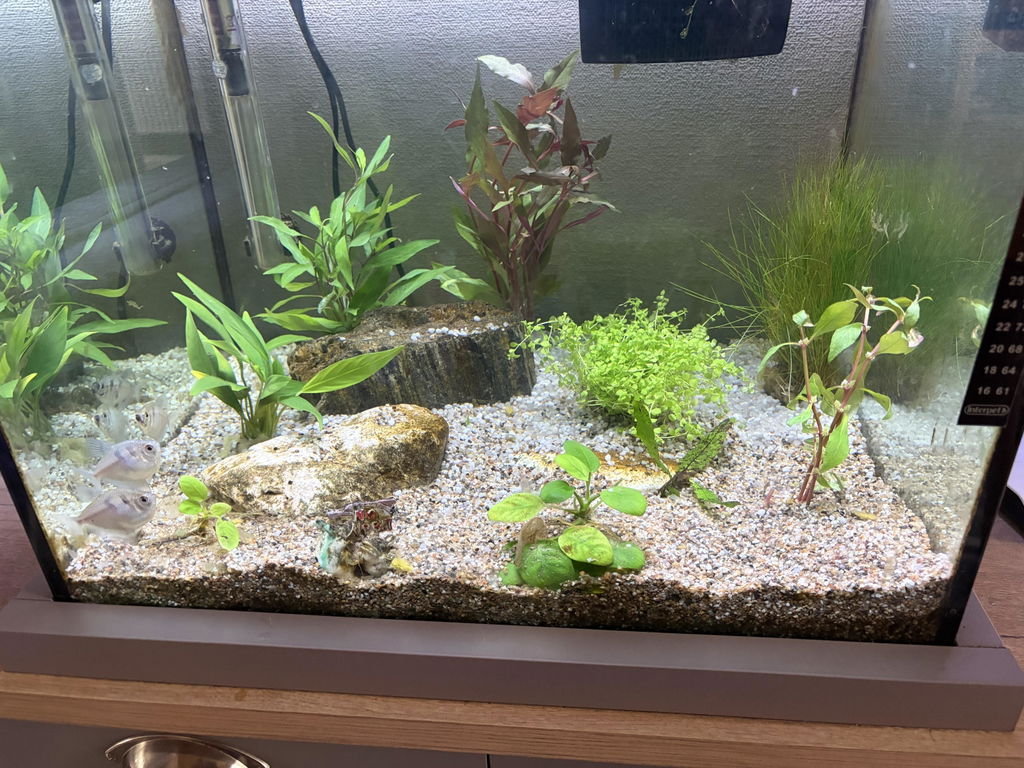


There's no single "best" aquarium plant — but there are plants that are best for your setup, your experience level, and the conditions in your tank. This guide helps you find them.
Rather than an endless list, we've focused on the species that consistently perform well for the broadest range of hobbyists: plants that are genuinely forgiving, visually rewarding, and available year-round.
How to choose: match plant to tank
Before choosing a plant, answer three questions:
- Do you have CO2 injection? Demanding plants like HC Cuba, Rotala, and most carpeting species need it. Without CO2, stick to the robust species below.
- What kind of light do you have? A basic starter light supports low-demand species. A quality LED or T5 opens up a much wider range.
- What fish are in the tank? Some fish eat soft plants; if so, focus on tougher species.
If you're new to the hobby or keeping it simple, every plant below will work without CO2 and in moderate lighting.
The best aquarium plants for most setups
Java Fern (Microsorum pteropus)
Java Fern is arguably the single most beginner-friendly aquarium plant in existence. It tolerates a wide range of water conditions, grows in low to moderate light, needs no CO2, and doesn't require substrate — it attaches to wood and rock. Most fish leave it completely alone. New plants grow as plantlets directly off the leaves, so it self-propagates. A near-perfect plant.
Anubias nana
If Java Fern is the easiest background plant, Anubias nana is the easiest foreground and midground plant. Thick, waxy leaves that fish won't eat, low light preference, no CO2 needed, and a life expectancy measured in years rather than months. Attach it to driftwood, dose fertiliser daily, and leave it alone — it will reward patience.
Java Moss (Taxiphyllum barbieri)
Java Moss grows on almost any surface, in almost any conditions. Attach it to driftwood, rock, or mesh; let it float; carpet the foreground. It's also brilliant for shrimp tanks and breeding setups where fish fry need cover. The most versatile plant on this list.
Cryptocoryne (various species)
Crypts are the ideal rooted plants for low-tech setups. They prefer being planted in substrate, where they establish a good root system and become increasingly stable over time. Cryptocoryne wendtii is the most widely available and tolerant — it comes in green, red, and brown forms, grows to a useful 10–15 cm, and suits foreground to midground positions depending on tank depth.
Echinodorus bleheri (Amazon Sword)
The classic large background plant. Echinodorus bleheri grows to 30–50 cm with broad, striking leaves. It's a root feeder, so pair it with root tabs for best results, but it's otherwise undemanding. Perfect for providing scale and structure in larger tanks. One well-grown Amazon Sword can transform a background.
From Aqua Essentials
All five plants above thrive with a simple daily fertiliser routine. Neutro T covers everything they need in the water column, and Neutro TerraTabs root tabs are ideal for the crypts and Amazon Sword. No CO2 required for any of them.
Shop Fertilisers →Best plants if you have CO2
If you're running pressurised CO2 and good lighting, you can move into more demanding but visually spectacular territory:
- Rotala rotundifolia — fast-growing red stem plant, excellent for adding colour to the background
- Micranthemum Monte Carlo — the most forgiving carpeting plant, creates a lush green foreground lawn
- Pogostemon helferi — compact foreground plant with distinctive star-shaped rosettes
- Hemianthus callitrichoides (HC Cuba) — the finest carpeting plant available, truly stunning when established but needs high CO2 and light
What to avoid as a beginner
A few species are frequently sold as easy but really aren't:
- Cabomba — looks beautiful in the shop, disintegrates within weeks in typical home setups
- Limnophila aquatica — needs very high light and CO2, otherwise melts
- Non-aquatic plants — Peace Lily, Lucky Bamboo, and many bright-coloured plants sold in pet shops are terrestrial species that will die submerged
When in doubt, if a plant isn't labelled with its Latin name, be cautious.
From Aqua Essentials
Not sure where to start? Our mixed plant bundles are a great way to get a selection of proven species at once — everything in our bundles is a genuine aquatic plant, correctly labelled. We also categorise plants by difficulty on every product page, so you can always tell what you're buying.
Shop All Plants →Frequently asked questions
What is the easiest aquarium plant?
Java Fern and Anubias nana are consistently the most tolerant aquarium plants available. Both survive a wide range of water conditions, grow in low light, require no CO2, and can be attached to wood or rock rather than planted in substrate. Either is an excellent starting point.
What plants grow best in aquariums without CO2?
Java Fern, Anubias, Java Moss, Cryptocoryne, and Amazon Sword are all excellent without CO2. Add liquid carbon daily to provide a carbon source alongside a complete liquid fertiliser, and these species will grow well in most tanks.
Which aquarium plant grows the fastest?
Fast-growing stem plants like Egeria densa, Hornwort, Hygrophila polysperma, and Vallisneria can grow several centimetres per day in good conditions. They're excellent for new tanks as they rapidly absorb nutrients and outcompete algae while slower species establish.
Can I mix easy and advanced plants in the same tank?
Yes, but design the tank around the needs of the most demanding species. If you want demanding plants like HC Cuba, you need high CO2 and strong lighting — and the easier species alongside them will simply benefit from those conditions too.